Mo Beans is a rare origin roaster built on stories, quality, and exclusivity — for those who value experience, culture, and exceptional beans. Every release is selected not only for its profile, but for its origin, its people, and the story behind it. We source hard-to-reach, high-quality beans from farms most roasters will never access, then roast in precise small batches to order and ship within 72 hours.
Our subscription delivers rare, small-batch beans directly to your door each month, with early access to every limited release before it reaches the public. These are not everyday beans — they're carefully chosen for their origin, character, and uncompromising quality. No filler. No shortcuts.
From soil to sip, every bean tells a story.
Three hundred farmers. One valley on Uganda’s southwestern border. Read the Kigezi story →
Three hundred farmers. One valley on Uganda's southwestern border. A minimal-intervention natural from a variety most of the coffee world has forgotten. Click to read the full story.


Ten smallholder farmers in Ducurai Village, high in the Ermera district of Timor-Leste, between 1,400 and 1,700 metres on the slopes of Tatamailau. Certified organic, hand-picked, home-processed and raised-bed dried, organised through Café Brisa Serena at $3.50 per kilogram of dried parchment. The variety is the Timor Hybrid — a natural cross between Arabica and Robusta first identified on this island — still growing where it was found.
Roasted light. Strong early heat and a controlled taper maximise caramelisation while preserving the Timor Hybrid's zest. Deep, layered sweetness — caramel, crème brûlée, flan — over dark chocolate and spice, lifted by lemongrass and grapefruit pith. Rich, rounded, almost dessert-like.
Three hundred farmers. One valley on the Rwandan border. A forgotten Typica dried slowly in the sun — the full account of how Drop 002 came to exist.
The gap between specialty single-origin coffee and mass-produced store coffee is measurable — in flavor, in freshness, and in what the body actually receives.
"The cup you drink every morning is either working for you or against you."
Order Drop 002 — $30 →Drop 001 was the foundation. Drop 002 is in stock now. We are already in conversation with producers across origins that most roasters will never visit — including releases well above and well below this price. The drop list receives access before anyone else.
Origins disclosed to the drop list exclusively, before public announcement.
Every coffee we release carries complete provenance — the farm, the producer, the altitude, the process. We do not trade in anonymity.
Each lot receives its own roast profile, developed independently. The difference between a good cup and an extraordinary one lives in that precision.
We release coffees when they are ready, when the lot is exceptional, and when the story is worth telling. Limited by design — not as a tactic, but as a standard.
Your coffee is roasted after you place your order and dispatched within 72 hours. No warehouse stock. Every bag arrives at peak freshness.
We carry one coffee at a time because that is the only way to carry it properly. Every offering has been rigorously evaluated before it reaches you.
We pay meaningfully above commodity pricing because quality sourcing demands it. Better compensation produces better farming, which produces a better cup.
Rare-origin coffee delivered monthly, roasted to order. First access to every limited release before anyone else.
One rare-origin bag monthly. The perfect entry into exceptional coffee.
For the discerning drinker who refuses to settle for ordinary.
Subscribe — $25/mo →Cancel anytime. No minimums.
Two rare-origin bags monthly. For the household that takes coffee seriously.
For those who demand the best, more than once.
Subscribe — $40/mo →Cancel anytime. No minimums.
Three rare-origin bags monthly. The complete rare origins experience.
For the obsessive. The collector. The one who wants everything.
Subscribe — $55/mo →Cancel anytime. No minimums.
Not ready to subscribe? Order Drop 002 for $30 →
Subscribers receive origin announcements and early access windows before they are made public.
No spam. Unsubscribe anytime.
Ten farmers. One island. A certified organic washed coffee cultivated at 1,700 metres, where a naturally occurring varietal cross created something the coffee world has never been able to replicate.

Timor-Leste sits at the far edge of the Indonesian archipelago — a small, often overlooked island nation just north of Australia. It's one of the youngest countries in the world, having only gained full independence in 2002 after centuries of occupation. That history still shapes daily life here — and makes what's being built through coffee even more meaningful.
Despite its size, Timor-Leste plays an outsized role in the global coffee story. Nearly 25% of the population depends on coffee for their livelihood, and deep within its inland forests is where one of coffee's most important genetic discoveries occurred — the Timor Hybrid — a natural cross between Arabica and Robusta that would go on to influence cultivars across the world.
In the mountain district of Ermera, the landscape shifts quickly from hot coastal lowlands to steep, rugged highlands. Villages like Ducurai sit between 1,400–1,700 meters near the slopes of Tatamailau, the country's highest peak. These elevations are wrapped in cloud forest, cooled by altitude winds, and defined by sharp ridges and lush, grass-covered terrain — conditions that slow cherry development and concentrate sugars within the fruit.
It's a place of isolation, resilience, and biodiversity — and one of the few regions in the world where ancient Typica varieties still grow alongside the Timor Hybrid, preserved in a way that mirrors nearby Papua New Guinea. The result is a cup profile that feels both familiar and completely singular at the same time.
This release comes from ten smallholder farmers in Ducurai Village, part of a group known as Lebudu Kraik — meaning "lower wetlands," a name rooted in their position along the mountainside just north of Tatamailau.
These farmers operate on small plots, typically between 0.5 and 1.5 hectares, where coffee is not an industrial crop — it's a way of life. Trees are tended for decades, often growing tall and vine-like, requiring harvesters to lean long wooden ladders against the canopy to reach the cherries. Every cherry is picked by hand, processed at home using hand-built or shared pulping equipment, and fermented in small personal containers before being dried carefully on raised beds.
Their farms are shaded by evergreen she-oaks, which naturally mulch and fix nitrogen into the soil, and most producers maintain additional crops like taro and cassava, along with livestock such as pigs, goats, and fowl. Many also operate personal compost systems, reinforcing a deeply rooted, organic approach to farming.
These ten farmers are organized through Café Brisa Serena (CBS), a social enterprise that has spent over a decade developing smallholder coffee systems in the region. Originally supported by Peace Winds Japan — a humanitarian organization active in Timor-Leste following independence — CBS has evolved into one of the most traceable and transparent exporters working with smallholder producers today.
For this harvest, the Lebudu Kraik group received $3.50 per kilogram of dried parchment. Each year, detailed records are shared — including farmer names, farm data, and exact prices paid. This isn't anonymous supply. This is traceable, relationship-driven coffee — built on trust, structure, and long-term investment in doing things the right way.

The Timor Hybrid is one of the most important genetic developments in coffee history — a natural crossing between Arabica and Robusta first identified on this island in the early 20th century. Its resilience to disease and adaptability to changing climates have made it foundational to breeding programs across the globe.
But here, in Ermera, it's not just a genetic reference — it's still growing in its original environment.
What makes this coffee stand out is the balance it achieves. From its Robusta lineage, you get structure, vibrancy, and a subtle zest. From its Arabica roots, you get clarity, sweetness, and refinement. Together, they create a profile that is both complex and incredibly approachable.
One of the defining characteristics I look for in Timor Hybrid coffees is how the sugars develop and caramelize — and this harvest delivers exactly that. There's a deep, layered sweetness that builds into notes of caramel, crème brûlée, and flan, supported by a classic foundation of dark chocolate and spice.
At the same time, the cup lifts with brighter, aromatic elements — lemongrass, grapefruit pith, and subtle herbal notes like sage and palo santo — creating a balance that keeps it from ever feeling heavy. The texture is where it really stands out — rich, rounded, and almost dessert-like, with a mouthfeel that leans toward pudding and chocolate truffle.
Some coffees seek to challenge preconceived notions of origin characteristics, and some coffees highlight and elevate what makes the region unique. This coffee from the farmers of Lebudu Kraik fulfills the promise of the latter — distinctly Timor in its profile, and profoundly enjoyable in the cup.
From soil to sip, every bean tells a story. — Mo Beans
Only 5 bags remain from the first release. Roasted to order and shipped within 72 hours. When they're gone, Drop 001 closes for good.
Free shipping · Roasted fresh · Ships within 72hrs
The green is notably clean for the region — stable moisture content and a condensed screen size that allows for even heat transfer and consistent development. Strong early heat followed by a controlled taper maximizes caramelization while preserving the Timor Hybrid's lively zestiness. It's a coffee that behaves predictably, giving you control over how those sugars are expressed — and when handled right, it produces a cup that feels both comforting and elevated. Espresso: moderate dose, high yield. Pour-over: finer grind, extended bloom 45–60 seconds.
Caramelized sugar and dark chocolate dominate. The key is a high yield and moderate extraction time.
Lemongrass and grapefruit pith lift into the cup. Finer grind and extended bloom bring out the aromatic character.
Three hundred farmers. One valley on the Rwandan border, in a country where almost nobody looks for great arabica. A forgotten Typica, dried whole in the sun and left alone — and a cup that comes out tasting like lavender and berry jam.
Uganda is one of the largest coffee exporters on the African continent, and almost none of it is the kind of coffee anyone writes about. Roughly four bags in five are robusta, grown low and warm, sold into blends and instant, priced by the tonne. Great arabica exists here, but it is genuinely rare — the exception rather than the reputation.
The Kigezi Highlands are the exception. Tucked into the far southwestern corner of the country, pressed against the Rwandan border below Kabale, this is a landscape of impossibly steep terraced hills — the "Switzerland of Africa," as the tourism copy has it, though the farmers here would tell you it mostly means everything is uphill. The terroir is a direct continuation of Rwanda's most celebrated growing regions; the border is a line on a map, not a change in the soil.
Coffee grows here between 1,500 and 2,700 metres. At that altitude the nights are cold, the cherries ripen slowly, and the sugars have time to concentrate inside the fruit instead of racing to maturity. It is exactly the condition specialty coffee is built on — and for most of Uganda's coffee history, almost nobody was set up to take advantage of it.
This lot comes from three hundred smallholders working with Kigezi Valley Coffee, organised by Mountain Harvest — a producer group that describes itself, fairly, as the antithesis of Uganda's typical coffee value chain.
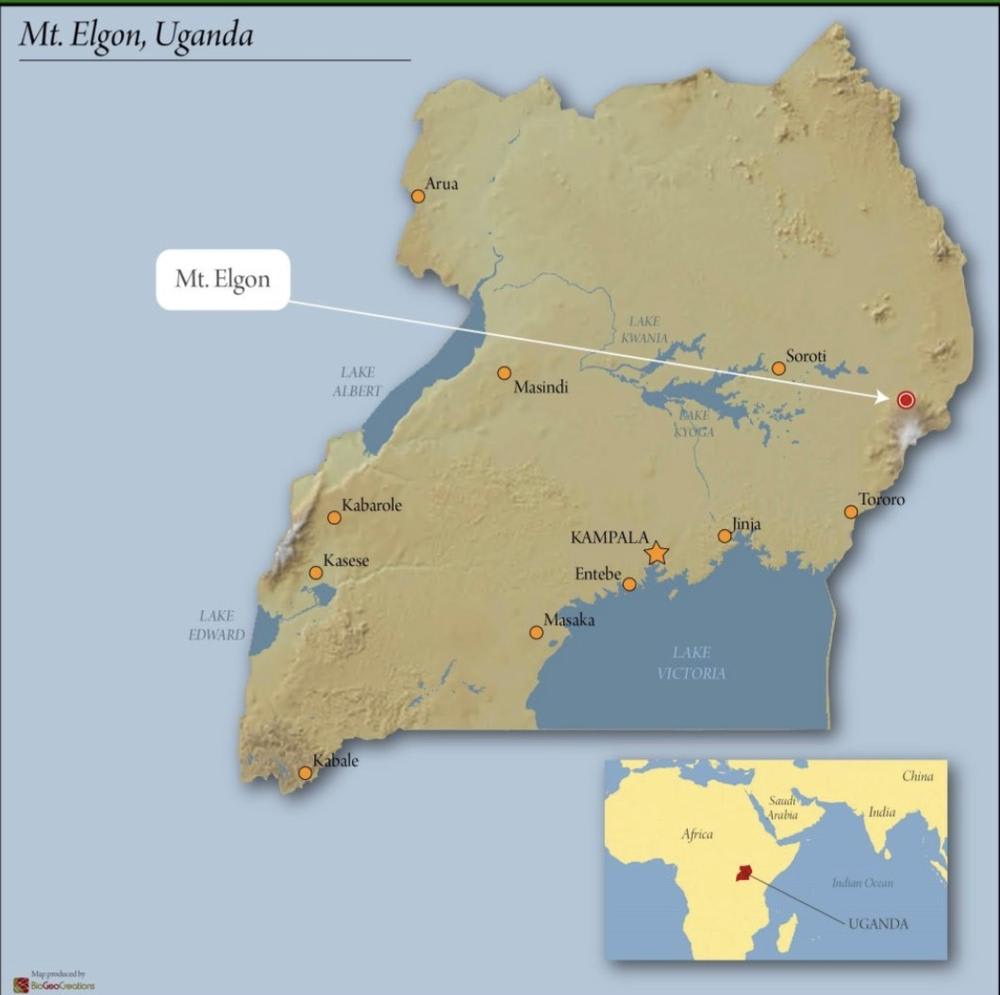
The usual arrangement in Uganda is a long line of middlemen between a farmer and a buyer, each one taking a margin and none of them accountable for quality. Mountain Harvest inverted it. They spent five years on the slopes of Mt. Elgon, on the far eastern side of the country, building farmer relationships, transparent pricing and processing infrastructure before they expanded anywhere. In 2023, they brought that model west to Kigezi.
What that buys, in practice, is patience. Cherry is picked ripe and sorted for impurities before it ever reaches a bed. Nothing is rushed to hit a boat date. Farmers are paid on quality rather than volume, and they know what the coffee sold for. It is a slower, more expensive way to run a supply chain, and it is the only reason a coffee like this one exists.
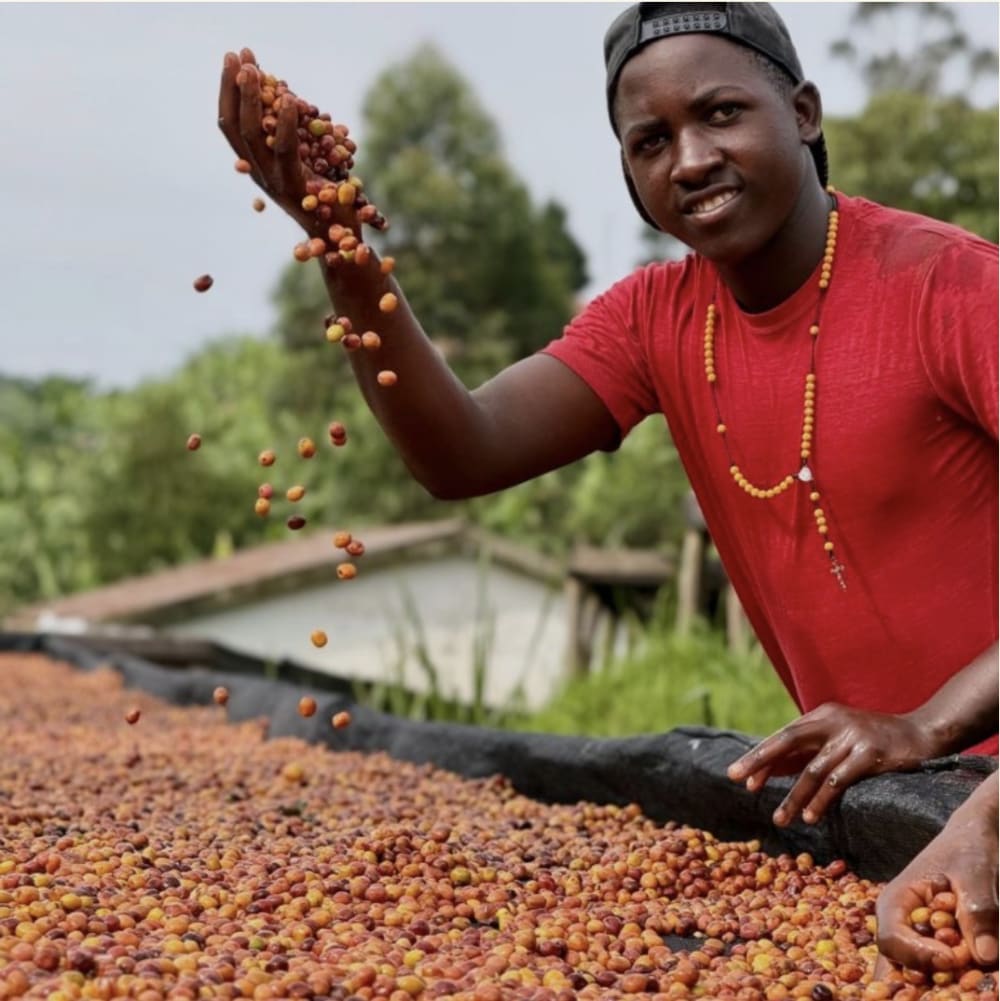
This is a natural — the whole cherry dried intact, fruit and all, so the sugars in the pulp work their way into the seed as it dries. It is the oldest processing method there is and the least forgiving. Get it wrong and you get vinegar, mould, ferment. Get it right and you get something no washed coffee can imitate.
Mountain Harvest calls their approach minimal intervention, which is a modest way of describing a great deal of work. The cherries go onto raised screen beds in thin layers. They are turned by hand and monitored daily — every day, for weeks — until they hit exactly 11% moisture. No mechanical dryers, no shortcuts, no accelerating the schedule because a container is waiting.
Then it rests. The dried parchment travels the width of the country to a temperature-controlled warehouse in Mbale and sits there for two full months, stabilising, before anyone mills or exports it. Most Ugandan coffee has been shipped and sold long before that clock runs out. This is the part almost nobody pays for, and it is the part you can taste.
The variety is Nyasaland — known locally as Bugisu, and carrying one of the more improbable passports in coffee. It is a Typica descendant, part of the same narrow genetic line that produced Jamaica Blue Mountain. It was carried to what was then Nyasaland — today's Malawi — in the late 1800s, moved north into Uganda in the early 1900s, and then quietly kept growing while the rest of the coffee world moved on to higher-yielding, more disease-resistant plants.
Old Typica selections are difficult in every commercial sense: low-yielding, vulnerable to leaf rust, uncooperative. They survive in places where nobody had a reason to tear them out. Today, that makes Nyasaland genuinely rare — and, in the cup, unmistakable.
What comes out is floral before it is anything else: lavender and rose, lemon, then a wave of red fruit — strawberry, blueberry, berry jam, stone fruit, plum, pluot, pear tart. Underneath it there's honey and raisin sweetness and a deep chocolate base holding the whole thing together. It is bright and dense at the same time, which is a difficult trick, and it is entirely down to the variety, the altitude and the two months nobody rushed.
Map: Mountain Harvest began on Mt. Elgon in eastern Uganda in 2017 and expanded to the Kigezi Highlands, in the far southwest, in 2023.
From soil to sip, every bean tells a story. — Mo Beans
Source this coffee yourself. Talk your way past Mountain Harvest, survive the road southwest, save the drying beds when the rain comes, and decide whether to wait out the sixty-day cure in Mbale. Twelve rare beans to collect.
Limited quantity. Roasted to order and shipped within 72 hours of roast. In stock now — when it is gone, it is gone.
Three hundred farmers, weeks on the raised beds, two months resting in Mbale before a single bag ships. In stock now — get yours before the run closes.
Order Now — $30 →Free shipping · Roasted to order · Ships within 72hrs of roast
This one rewards a gentle, slower hand. The green reads soft — density below average, water activity slightly above, moisture at 10.5% across a 15–18 screen — which means it takes heat faster than it looks like it should. Stretching the drying phase and pulling back heat early is what protects the fruit; push it and the lavender and berry collapse into generic roast sweetness. We take it light and stop short. Espresso: workable, but this coffee is happiest as filter. Pour-over: fine grind, slightly lower dose, conical brewer.
Where this coffee belongs. The floral top end — lavender, rose, lemon — needs a clean extraction and a fast enough flow to stay lifted.
Naturals this delicate can go syrupy fast. Treat it as a light modern shot and let the berry sweetness carry it rather than chasing body.
Rare-origin coffee delivered monthly, roasted to order, with first access to every limited release.
One rare-origin bag monthly. The perfect entry into exceptional coffee.
For the discerning drinker who refuses to settle for ordinary.
Subscribe — $25/mo →Cancel anytime. No minimums.
Two rare-origin bags monthly. For the household that takes coffee seriously.
For those who demand the best, more than once.
Subscribe — $40/mo →Cancel anytime. No minimums.
Three rare-origin bags monthly. The complete rare origins experience.
For the obsessive. The collector. The one who wants everything.
Subscribe — $55/mo →Cancel anytime. No minimums.
Not ready to subscribe? Order Drop 002 for $30 →
One, two, or three bags monthly.
Roasted to order, shipped within 72 hours — every month.
Same week each month. Skip or cancel anytime.
Mo Beans started with a simple frustration: most specialty coffee felt inaccessible, pretentious, or interchangeable. We wanted rare beans, real stories, and no filler.
The world grows millions of tons of coffee each year. Most is forgettable. In pockets of Timor-Leste, the valleys of southwestern Uganda, the highlands of Ethiopia, the remote mountains of Bolivia — farmers are doing something extraordinary. We go find them.
Ten smallholder farmers in Ducurai Village, organized around Café Brisa Serena. Certified organic. Full farmgate pricing. The Timor Hybrid — a natural cross between Arabica and Robusta found only here — produces a cup that can't be replicated anywhere else on earth.
Small batch. Every time. Every lot gets its own profile — a washed Timor Hybrid wants strong early heat and a controlled taper to build caramelization; a delicate natural like Kigezi wants a gentler, slower hand, a stretched drying phase and heat pulled back early to protect the fruit. We roast to order. Ships within 72 hours of roast.
Drop 001 opened the door. Drop 002 — a minimal-intervention natural from the Kigezi Highlands of Uganda — is in stock now. Beyond that we're sourcing releases at both ends of the range: something extraordinary and expensive, and something exceptional you can drink every day. We drop coffees the way a good label drops music: when it's ready, when it's exceptional. Join the drop list to find out first.
Email us with your order number and we'll make it right.